Planning a four-day fly fishing trip to the Catskills for a group: complete logistics and timing guide
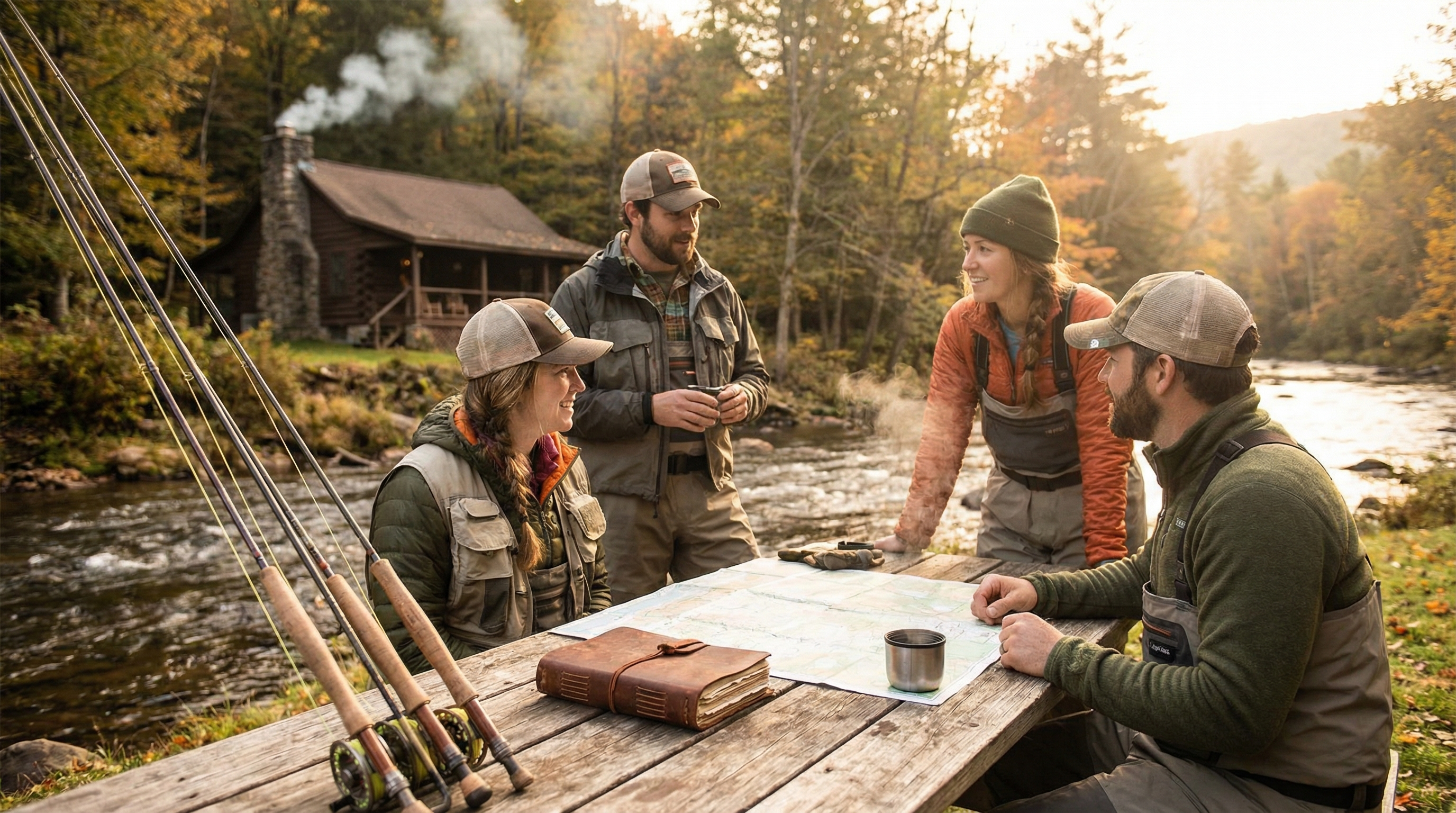
The Group Organizer's Field Guide: Planning a Four-Day Fly Fishing Trip to the Catskills
Twenty years of fishing trips taught us what a group actually needs: a real kitchen, a deck with room to plan tomorrow, and a house that feels like it belongs here. But before you're sitting at that table with a story to tell, there's the quiet work — the planning, the logistics, the small decisions that keep a four-day fly fishing trip from becoming four days of confusion. This guide walks you through every step, from the moment you think "we should do this" to the morning you're loading rods into the truck.
We've organized groups of eight, groups of three, beginners mixed with experts, and everything in between. The rhythm is always the same: pick your window, lock in your dates, audit your gear, confirm your access, and arrive ready to fish. Here's how.
Timing: Choosing Your Four-Day Window and Booking Early
The Upper Delaware River runs 73.4 miles as a federally designated National Wild and Scenic River, hosting roughly 40,000 to 60,000 angler-days each year. That volume matters when you're trying to book a fly fishing cabin property for peak season.
There are two golden windows for group trips, and both require advance planning.
The Sulphur Hatch: May–June
The sulphur hatch peaks from late May through mid-June — specifically May 25 through June 15. This is when the Upper Delaware fishes like a dream. The fish are feeding on predictable hatches, and dry-fly action in the evening can be prolific.
But here's the reality: lock in sulphur dates 3–5 months in advance. Groups targeting June 1–15 need to book by early April. If you're reading this in May and hoping for a late-May trip, you've likely missed the best dates.
Action step: If the sulphur hatch is your target, book in January or early February.
Fall Caddis: September–October
The fall caddis peak runs September 7–18 on the West Branch. The river is running cool and steady, thanks to the DRBC Flexible Flow Management Program, which typically delivers consistent flows in early fall. Spring runoff is a memory. Summer's heat has broken. The days are shortening, the light is gold, and you have a legitimate shot at hooking fish on small, skittering dries.
Fall trips need 4–5 months' lead time. Book by late April if September is your target. This is the unsung sweet spot — fewer groups are chasing it than May–June, and the fishing is just as good.
Summer and the Tailwater Advantage
July and August are worth knowing about: the Upper Delaware stays cold because of hypolimnetic cold-water releases from Cannonsville and Pepacton Reservoirs, managed by the Delaware River Basin Commission. While freestone Catskills streams overheat in midsummer, the West Branch holds temperature and holds fish. Book by March if summer is your window.
Gear and Group Logistics: The Two-Week Audit
The worst morning of a group fishing trip happens on Day 1 when someone pulls the wrong rod out of the truck and two hours vanish before anyone reaches the water. Prevention is simple: send a skill-level form two weeks before arrival.
The Pre-Trip Gear Form
Ask each angler: casting experience (beginner, intermediate, expert), rod weight preference, nymph vs. dry-fly preference, and any physical limitations. Then pre-assign rods:
- Beginners → 5–6 wt rods: Forgiving, less fatiguing over a full day on the water
- Intermediate/expert → 4–5 wt: Better for precise presentation in the Upper Delaware's pool-heavy water
- One shared 7–8 wt nymph rig: For heavy-water pools and weighted streamers — rotate it through the group as a teaching tool
A beginner on a 4-weight feels helpless; an expert on a 6-weight is bored. Matching gear to skill is the single fastest way to improve everyone's day on the water.
The Kitchen and Deck as Trip Headquarters
The West Branch stays productive all day, but by late afternoon the group scatters — two anglers are still on the water, two have driven into town, one is at the farm stand. By dinner, everyone is back at the table with a story.
A Catskills cabin for groups needs a real kitchen to do that moment justice — not a kitchenette, but full counter space, cast iron, and room to cook for six. It also needs a deck where the group can debrief the day and plan tomorrow's water. That 90 minutes around the outdoor table is as important to the trip as anything that happens on the river.
Permits, Access, and the 72-Hour Pre-Trip Email
Three days before you arrive, send one comprehensive logistics email to your group. This prevents eight separate calls on the drive north.
Licenses — and the NY/PA Misconception
You need only a New York State freshwater fishing license. You are not crossing into Pennsylvania, and you do not need dual licenses — this is the most common misconception we hear, and it costs groups unnecessary time and money.
- Cost: $25–30
- How: Buy a digital license through the NY DEC portal. It arrives the same day. Every angler age 16+ needs one.
Include the DEC link in your 72-hour email. One person always forgets.
River Access Confirmation
The Upper Delaware's flow is managed upstream by the DRBC. Releases can change conditions overnight. Confirm river access 48 hours before arrival by checking USGS gauge station 01438500 — Delaware River at Callicoon, NY — at waterdata.usgs.gov. Two minutes of checking saves a morning of wading into unfishable water.
What Your 72-Hour Email Should Cover
- NY fishing license reminder with DEC link
- Cabin check-in time
- Current flow reading from the Callicoon gauge
- Weather forecast (pack layers)
- Dinner plan for Day 1 — groceries in the cabin, stop on the way in, or we can help you coordinate dinner delivery?
What a Four-Day Trip Actually Looks Like
Day 1 is arrival and first water. Get there by midday, unload, grab licenses if anyone forgot, fish the afternoon. You're reading the river, testing the light, getting your legs under you. Dinner is easy — something hot, eaten on the deck.
Day 2 is the long day. Most wake before sunrise. By morning the group has split — one group is grinding hard and hitting every hole, another group is cherrypicking the rising fish. By late afternoon, when the light turns amber, everyone starts drifting back to the productive hole of the day.
Day 3 is refinement. You know the river. You know who wants to fish certain sections, what peaks in the evening, what's working. The day has rhythm.
Day 4 is morning water and a slow pack-out. Fish until mid-morning, load up, drive south with new fish tales and dates already circled for next year.
Start Planning Your Trip
The best four days aren't accidents. They're the result of small, deliberate decisions made months/weeks in advance — the right window, the right gear, the right email to your group.
If you're ready to lock in dates for a sulphur hatch trip or an early fall caddis window, check availability for your Upper Delaware fishing trip and let us know your target dates. We'll hold the cabin while you finalize your group.